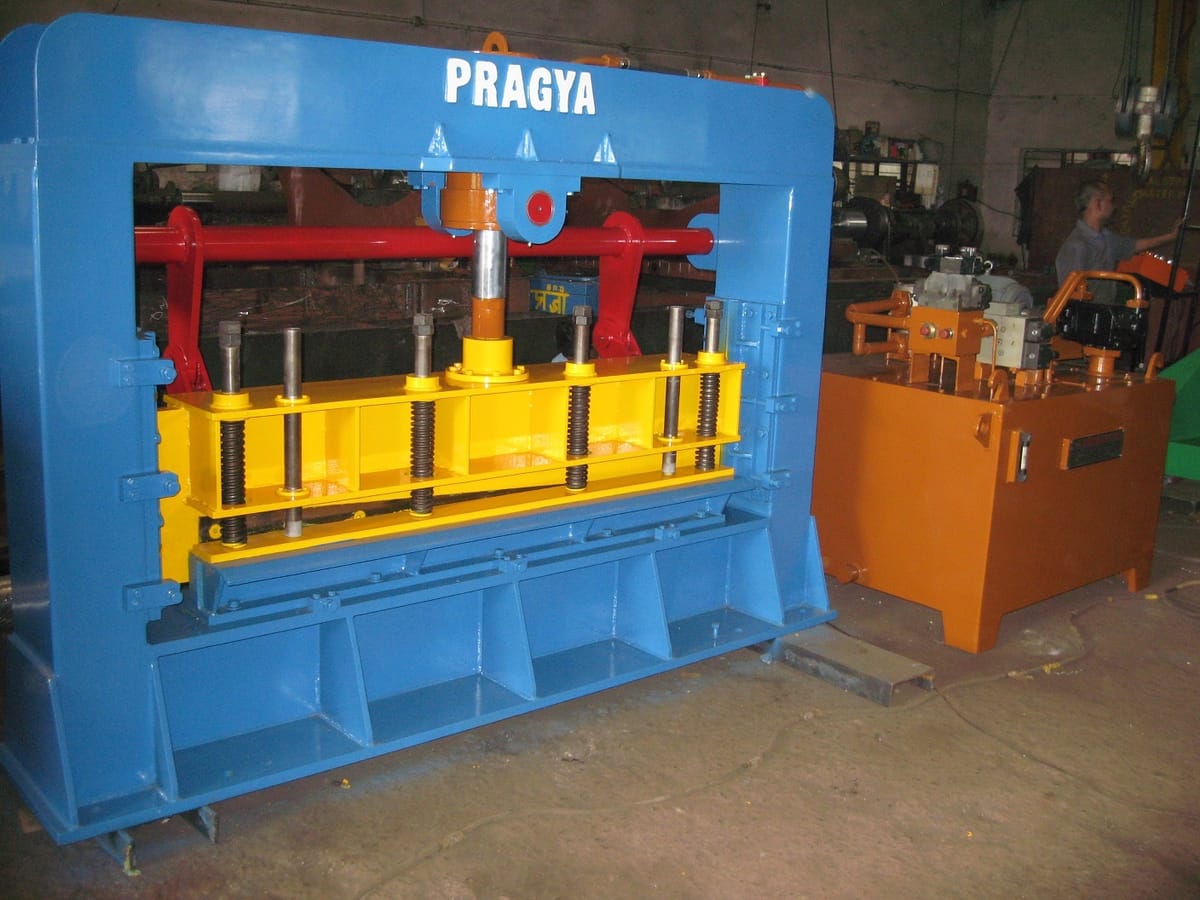
A hydraulic shear machine cuts steel plates and sheets to size using a hydraulically driven blade, producing clean, burr-free edges through consistent applied force rather than mechanical impact.
How it works
A back gauge positions the plate at the required cut length, and the upper blade descends under hydraulic pressure against the fixed lower blade, shearing through the material along a straight line. Because the force is hydraulic rather than mechanical-flywheel driven, the cutting action is more consistent across the stroke, which is part of why the resulting edge comes out clean rather than torn or burred.
Product variants
- Standard Shear — general-purpose cutting for mild and stainless steel
- CNC Shear — automated back gauge control for repeat-accuracy cutting
- Heavy-Duty Shear — built for thicker plates
Specifications
- Mild steel capacity: up to 6 mm
- Stainless steel capacity: up to 4 mm
- Cutting length: 3000-4000 mm
- Shear angle: 0.5°-1.8°
- Power: 12 kW and above
Key features
An adjustable blade gap and shear angle let the machine be tuned to different material thicknesses, the back gauge gives accurate, repeatable positioning, a CNC control option automates that positioning further, and safety guards with emergency stops are standard given the forces involved.
Applications
- Metal fabrication workshops
- Automotive manufacturing
- Shipbuilding and marine
- Sheet metal processing
Hydraulic shear machine vs. hydraulic press
It's worth being precise about the distinction: a shear machine cuts material by separating it along a line, while a hydraulic press forms material — bending, punching, or pressing it into shape without necessarily cutting it. If your process needs plates or sheets brought down to size before further work, a shear machine is the right tool; if the next step is forming or shaping, that calls for a hydraulic press or a bending and folding machine instead. Many fabrication lines use both in sequence — a shear machine to cut blanks to size, and a press or folding machine downstream to form them — so the choice usually isn't either/or but which operation comes first in your process.
Interested in our industrial equipment?
Our engineering team, based in Indore, Madhya Pradesh, India, will recommend the right solution for your plant requirements.
Request a quote