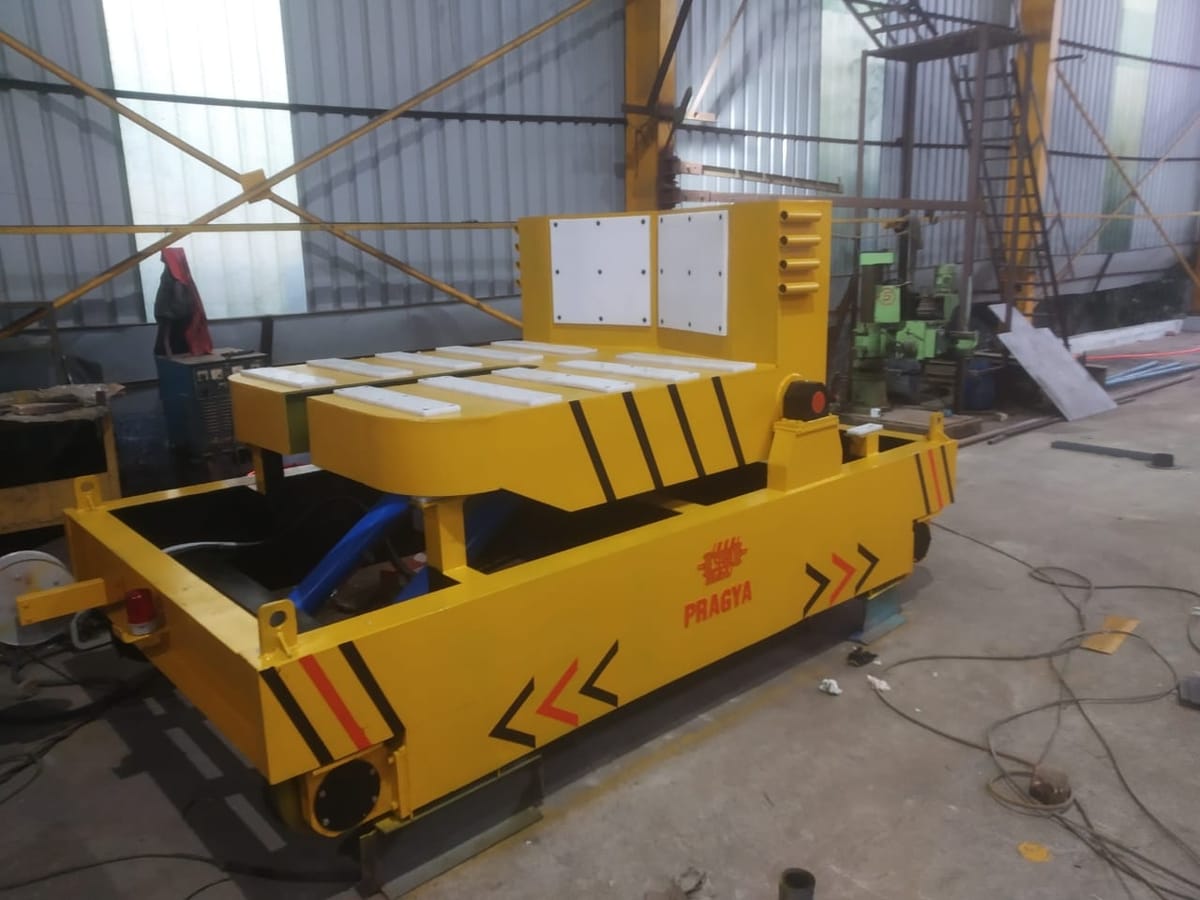
A trolley with tilter transports material between stations and rotates it through an angle of 0 to 90 degrees using an integrated hydraulic tilting mechanism, replacing what would otherwise be two separate pieces of equipment.
How it works
The unit combines a transport trolley base with a hydraulic tilting platform mounted on top. Once the load is moved to the required station, the tilter rotates it — anywhere from a slight incline up to a full 90 degrees — for loading, unloading, or positioning the material at the angle the next process step needs. Because tilting and transfer are built into one frame, there's no intermediate handoff between a separate trolley and a separate tilter, which removes a step from the material flow and one more point where the load could be mishandled.
Product variants
- Hydraulic Trolley with Tilter — smooth, controlled hydraulic rotation
- Motorised Trolley with Tilter — self-propelled base with tilting
- Heavy-Duty Trolley with Tilter — higher-capacity model for larger loads
Specifications
- Load capacity: customizable to the application
- Tilting angle: 0-90 degrees
- Tilting: hydraulic mechanism
- Drive: manual or motorized
- Standards: CE certified
Key features
Combined transport and tilting, smooth hydraulic operation, an adjustable tilting angle, and a stable platform with safety features are the core capabilities. Load capacity is customizable rather than fixed to a single rating, so the unit is typically specified against the actual material and process it's built for.
Applications
- Manufacturing material handling
- Loading and unloading operations
- Production line integration
- Service center operations
When a combined machine makes sense
A single-function motorised trolley or coil tilter is simpler and often cheaper if your process only ever needs one of the two actions — moving material, or rotating it — in isolation. A trolley with tilter earns its keep when both steps happen back-to-back at the same station: moving material into position and then tilting it, cycle after cycle. Combining them into one machine cuts the number of handling steps and the floor space needed for two separate units, which tends to matter most in production lines where throughput and station footprint are both tight constraints.
Interested in our industrial equipment?
Our engineering team, based in Indore, Madhya Pradesh, India, will recommend the right solution for your plant requirements.
Request a quote