A scissor-type trolley moves material between locations and raises or lowers it to the needed height using a hydraulic scissor mechanism, combining transport and vertical lifting in one unit.
How it works
The scissor mechanism is a set of crossed, pivoting arms that extend vertically as hydraulic pressure is applied, raising the platform in a straight, stable line rather than tilting or swinging it. Because the platform stays level through the full lift range, it suits loads like coils that need to arrive at the destination height without being tipped or rotated. The trolley itself can be moved manually or under motorized drive, then the scissor lift is actuated to bring the load to the exact height needed at that station.
Product variants
- Standard Trolley — hydraulic scissor lifting for general-purpose transfer
- Heavy-Duty Trolley — rated up to the full 35 ton capacity
- Self-Propelled — motorized mobility instead of manual pushing
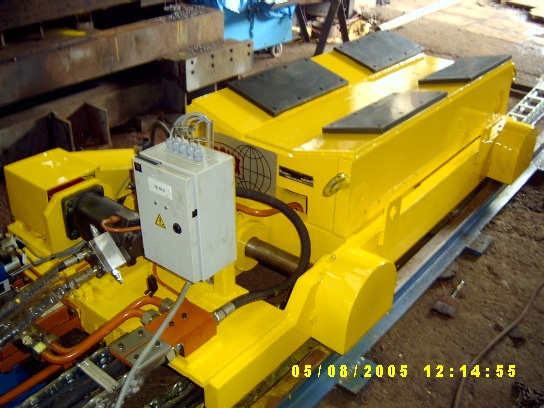
Specifications
- Load capacity: up to 35 ton
- Lifting: hydraulic scissor
- Drive: manual or motorized
- Construction: heavy-duty steel
- Standards: CE certified
Key features
Smooth hydraulic scissor lifting, combined transport and lift in a single machine, adjustable lifting height, and a stable platform design are the core features. These matter most where a load needs to be raised or lowered to match different process station heights along a line, rather than delivered at one fixed elevation.
Applications
- Warehouse material handling
- Loading dock operations
- Industrial positioning
- Manufacturing facilities
Scissor-type trolley vs. trolley with tilter
Both machines start from the same trolley base, but they solve different problems. A scissor-type trolley changes the load's height in a straight vertical path — useful when the destination station simply sits at a different level. A trolley with tilter instead rotates the load through an angle (0-90°) for loading, unloading, or orientation changes, without necessarily changing its height. If your process needs height adjustment, the scissor mechanism is the more direct answer; if it needs the load rotated for the next step, the tilter variant is the better fit. Some lines end up needing both functions, which is where a combined trolley-with-tilter unit becomes worth considering instead of running two separate machines.
Interested in our industrial equipment?
Our engineering team, based in Indore, Madhya Pradesh, India, will recommend the right solution for your plant requirements.
Request a quote