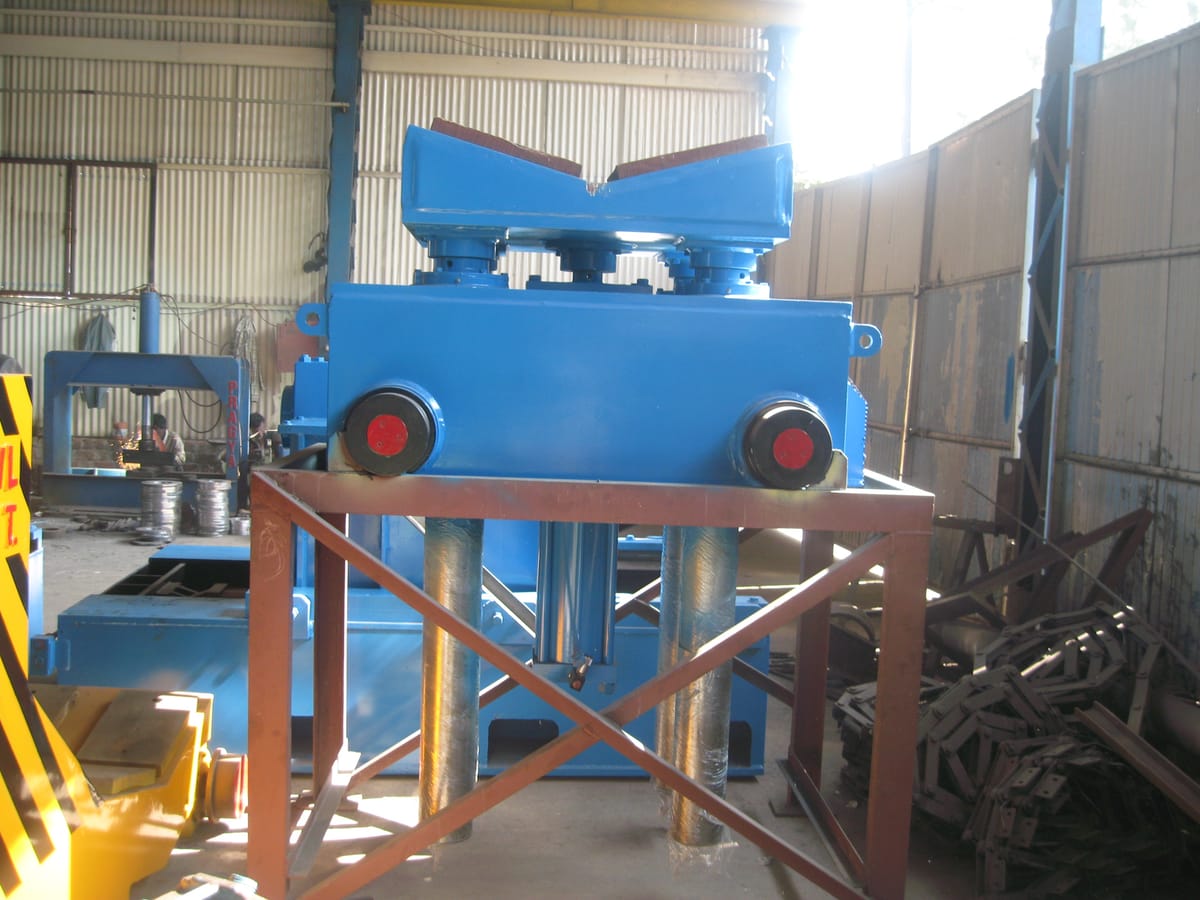
A pillar-type coil car lifts a steel coil and transports it along a fixed rail between two points in a mill or service center, combining the lifting and transfer functions into a single machine built around a rigid pillar structure.
How it works
The car rides on a fixed rail, and its pillar houses the lifting mechanism that raises and lowers the coil cradle. Because the lifting and travel path are both integrated into one frame, the car handles pick-up, transport, and set-down without needing a separate crane cycle for each step. This makes it well suited to routes that repeat constantly — for example, moving coils from a furnace exit to a cooling bed, or from a pickling line to a slitter infeed.
Product variants
- Hydraulic Pillar Coil Car — hydraulic lifting and positioning, suited to applications needing smooth, controllable lift speed
- Electric Pillar Coil Car — electric drive with gearbox for travel and lift
- Combined Lifter-Car — integrated lift and transport in a single unit
Specifications
- Load capacity: up to 35 ton
- Speed: up to 100 m/min
- Drive: electric or hydraulic
- Lifting: hydraulic mechanism
- Standards: CE certified
Key features and applications
Key features include hydraulic precision lifting, high-speed transportation, combined lift-and-transport operation, and robust pillar construction built for continuous-duty mill environments. Typical applications are steel mill coil handling, inter-station transport, storage and retrieval, and service center operations where a car runs the same route repeatedly during a shift.
Pillar-type coil car vs. other transfer equipment
The defining trait of a pillar-type coil car is the fixed rail: the travel path is set once during installation, which is exactly what makes it efficient for high-volume, repetitive coil moves — no operator has to steer or reposition it, and the rail geometry means every cycle takes the same path and time. Where a plant needs more routing flexibility, moving coils between multiple different pickup and drop points rather than a single fixed route, a motorised trolley (battery, cable-reel, or busbar powered) or a scissor-type trolley is usually the better fit, since neither is tied to a single rail.
Choose a pillar-type coil car when your coil flow between two fixed points is high-frequency and unlikely to change — the fixed-rail layout trades flexibility for speed and reliability on that specific route. If your yard or line layout still evolves, or coils need to reach more than one or two stations, a motorised trolley keeps that option open.
Interested in our industrial equipment?
Our engineering team, based in Indore, Madhya Pradesh, India, will recommend the right solution for your plant requirements.
Request a quote